Large tree stumps can create more than an eyesore on a commercial property. They can interfere with mowing, landscaping, pedestrian areas, parking spaces, drainage improvements, and future construction plans. For property managers, the challenge is often more complicated because a stump may be located close to buildings, sidewalks, utility areas, fences, or other landscaped features.
This is why commercial stump grinding is usually approached differently from a small residential stump project. Professional stump grinder contractors near me searches often lead property managers to companies that can evaluate the site, determine appropriate equipment, establish a safe work area, and grind the stump to a practical depth.
The process is not simply a matter of placing a machine over the stump and cutting it down. Large stumps may have extensive root systems, difficult access conditions, and surrounding obstacles that require planning before grinding begins.
For businesses, HOAs, rental properties, and other managed properties, understanding the process can make it easier to plan the work and communicate expectations with a tree-care contractor.
What Makes Large Commercial Tree Stumps Different?
A large stump on a commercial property can present several challenges that may not exist in a typical residential yard.
Stump Size and Root Structure
The larger the removed tree, the more material there may be below and around the visible stump. Some mature trees develop substantial lateral roots that extend beyond the immediate stump area.
Before grinding, contractors need to consider the stump’s diameter, height, root flare, surrounding soil, and the desired finished grade.
Restricted Access
Commercial properties frequently have limited access for heavy equipment. A stump might be located behind a building, between parking spaces, beside a sidewalk, or inside a landscaped area.
The available access can influence which type of stump grinder is appropriate. Contractors may need to use compact equipment where space is limited or select heavier equipment when the site allows it.
Nearby Structures and Property Features
A commercial stump may be close to:
- Buildings
- Sidewalks
- Parking areas
- Fences
- Irrigation systems
- Landscaping
- Driveways
- Retaining features
- Utility infrastructure
These conditions require a site-specific approach. The contractor needs to understand what is around the stump before beginning work.
How Commercial Stump Grinder Contractors Handle Large Stumps
Professional stump grinding generally starts with an inspection rather than immediate equipment operation. The contractor evaluates the stump, surrounding area, access, and intended use of the site.
1. Inspecting the Property
The first step is determining what needs to be done and identifying conditions that could affect the work.
For property managers, this assessment can be particularly important when several stumps are spread across a property. The contractor may document their locations and determine whether each stump requires the same equipment and grinding approach.
The inspection can also help identify surface roots and obstacles around the stump.
2. Selecting the Right Equipment
Commercial contractors may have access to different types of stump grinders, ranging from compact machines to larger, more powerful units.
Equipment selection depends on factors such as:
- Stump diameter
- Stump location
- Ground conditions
- Available access
- Number of stumps
- Required grinding depth
- Nearby structures
- Overall project scope
A compact grinder can be useful in restricted spaces, while larger equipment may be more efficient for accessible commercial sites with multiple substantial stumps.
3. Preparing the Work Area
Before grinding starts, the work zone should be assessed and prepared.
On a commercial property, this can mean considering pedestrian traffic, parked vehicles, employees, residents, customers, and other activities taking place nearby.
Property managers may need to coordinate temporary access restrictions or scheduling changes so the contractor can work without unnecessary interference.
The goal is to establish a practical work area around the stump while reducing disruption to normal property operations.
4. Grinding the Stump
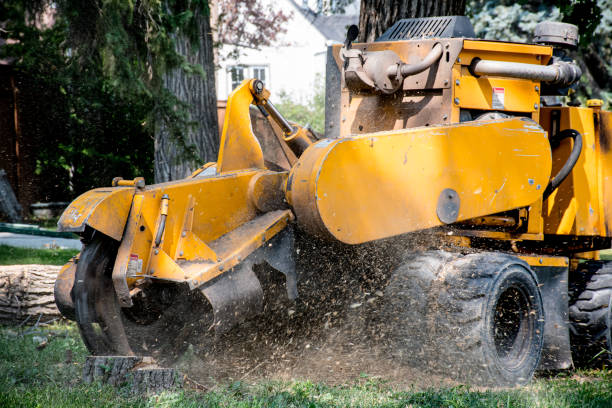
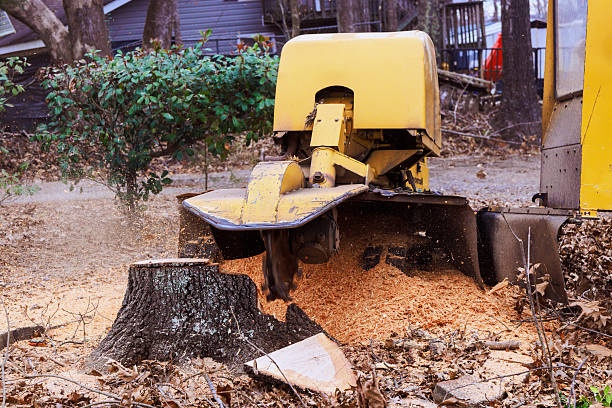
A stump grinder uses a cutting wheel equipped with cutting teeth to break the stump into smaller wood material.
The operator gradually works through the stump rather than attempting to remove the entire mass at once. The grinding pattern depends on the stump’s size, location, and required finished grade.
Large stumps can require multiple passes. The operator may work across the stump from different directions until the desired portion has been processed.
For commercial projects, consistency can be particularly important when several stumps are being handled across the same property.
5. Managing Surface Roots
Large trees can leave roots extending outward from the central stump. Depending on their location and the property manager’s plans, some surface roots may also need attention.
Kansas Tree Experts describes its stump grinding service as including work below grade and surface-root management to help prepare areas for sod, replanting, or hardscaping.
The exact treatment depends on site conditions. Not every root should automatically be removed, especially where doing so could affect surrounding vegetation or property features.
6. Handling the Ground Material
Grinding produces wood chips and other organic material. The amount depends on the size and number of stumps being processed.
After grinding, the contractor and property manager should understand what happens to this material. It may be used as fill in appropriate areas, removed from the site, or handled according to the agreed scope of work.
For commercial properties, this detail matters because the property may need to be ready for another contractor, landscaping project, parking improvement, or routine maintenance.
7. Reviewing the Finished Area
The final stage involves checking the work area and determining whether additional cleanup or material management is needed.
The finished area should be evaluated against the original project requirements. If the property manager intends to install grass, landscaping, pavement, or another feature, the contractor should know this in advance because the intended end use can influence the grinding requirements.
Equipment Used by Commercial Stump Grinders
Not every stump requires the same machine. Experienced contractors select equipment according to the project rather than relying on one grinder for every situation.
| Equipment or Method | Common Application | Key Consideration |
|---|---|---|
| Compact stump grinder | Restricted-access areas | Easier access through narrow spaces |
| Larger stump grinder | Large, accessible stumps | Suitable for substantial grinding projects |
| Remote-controlled grinder | Challenging or specialized work areas | Operator can work from a controlled position |
| Support equipment | Larger commercial projects | Helps with material handling and site preparation |
| Tub grinder | High-volume woody debris | Generally used for processing larger quantities of wood material |
A tub grinder service near me search can therefore mean something different from a stump grinder search. Tub grinders are generally associated with processing larger quantities of woody material rather than simply grinding an individual stump in place.
Property managers should describe the actual job when requesting estimates so the contractor can determine what equipment is appropriate.
Why Access Matters on Commercial Properties
Access is one of the most important factors in commercial stump grinding. Kansas Tree Experts considers the location of the stump, available access points, and surrounding property features when determining how a commercial stump grinding project can be approached.
Consider an apartment complex where a stump is located between a building and a sidewalk. A large machine may not be able to reach the area, so a smaller grinder could be more appropriate. Conversely, a large commercial property with open grounds and multiple mature stumps may provide enough access for larger equipment.
By evaluating access before work begins, Kansas Tree Experts can help identify the equipment and approach that best fit the property’s layout and the specific stump grinding requirements.
Parking Lots and Business Properties
A stump near a parking lot may require consideration of vehicle movement, pedestrian traffic, curbs, and surrounding landscaping.
Scheduling may be arranged during lower-traffic periods when practical.
Apartment and Multi-Unit Properties
Property managers may need to account for residents, pets, vehicles, walkways, and shared outdoor spaces.
Kansas Tree Experts lists commercial tree services for businesses, HOAs, and property managers and identifies stump grinding among its tree-care services.
HOA and Community Properties
HOA properties may have multiple stumps distributed across common areas. In these cases, documenting each location and creating a clear scope of work can help prevent confusion about which stumps are included.
Stump Grinding vs. Stump Removal
The terms stump grinding and stump removal are sometimes used interchangeably, but they describe different approaches.
With stump grinding, specialized equipment cuts the stump into smaller pieces below the surrounding grade. The remaining underground roots generally stay in place and gradually decompose.
Complete stump removal involves extracting the stump and potentially a larger portion of its root system. This can disturb more soil and may require additional site restoration.
For many commercial landscaping projects, grinding is practical because the visible stump is eliminated without requiring excavation of the entire root system.
However, the right approach depends on what will happen to the property afterward. If construction or another major project is planned directly through the stump’s location, the property manager should explain those plans before work begins.
What Property Managers Should Ask Before Hiring a Contractor
A search for a stump grinder company near me can produce numerous results, but proximity alone does not determine whether a contractor is appropriate for a commercial project.
Property managers should consider several questions.
Does the Contractor Handle Commercial Properties?
Commercial projects can involve different scheduling, access, communication, and documentation requirements than residential work.
Ask whether the contractor has experience working around businesses, HOAs, rental properties, or other managed properties.
What Equipment Will Be Used?
The contractor should be able to explain what type of equipment is appropriate for the stump and why.
How Will Access Be Managed?
Discuss gates, sidewalks, parking areas, landscaping, and other access limitations before the project begins.
What Is Included in Cleanup?
Clarify whether grinding debris, chips, exposed soil, and other material are included in the scope.
How Deep Will the Stump Be Ground?
The required depth can vary according to the property’s future use. A landscaped area may have different requirements from an area being prepared for another project.
Are There Multiple Stumps?
If a commercial property has several stumps, provide a complete list or site map when possible. This can make estimating and scheduling more straightforward.
How to Find Stump Grinder Contractors Near Me
When searching for stump grinder contractors near me, property managers should focus on service suitability rather than simply choosing the closest listing.
A useful comparison can include:
- Commercial experience
- Available equipment
- Insurance and applicable credentials
- Site assessment process
- Access planning
- Cleanup expectations
- Grinding depth
- Scheduling requirements
- Scope of work
- Communication with the property manager
Local knowledge can also matter because contractors familiar with the area may better understand common property layouts, access conditions, and seasonal considerations.
The objective is to find a contractor that can evaluate the actual property and provide a scope based on the stump’s size and location.
When Should Property Managers Consider Professional Stump Grinding?
A stump may need attention when it interferes with routine property maintenance or a planned improvement.
Common situations include:
- Preparing a landscape bed
- Improving a lawn
- Removing a trip hazard
- Reclaiming a landscaped area
- Preparing space for hardscaping
- Clearing an area after tree removal
- Improving access around a property
- Addressing multiple old stumps
Kansas Tree Experts provides stump grinding along with tree removal, trimming, land and bush clearance, and commercial tree services in Wichita and surrounding communities.
This combination can be relevant when stump work is part of a broader tree-care project rather than an isolated task.
Commercial Stump Grinding With Kansas Tree Experts
Kansas Tree Experts identifies commercial tree services as part of its service offering for businesses, HOAs, and property managers. Its website also lists stump grinding as a dedicated service.
The company is based in Wichita, Kansas, and lists service coverage across Wichita and surrounding communities. Its stump grinding information explains that the service is intended to address stumps that interfere with mowing, gardening, landscaping, and other property uses.
For property managers evaluating a large stump, the useful starting point is to provide information about the stump’s approximate size, location, access conditions, nearby structures, and intended use of the area.
You can review the company’s tree-care services and commercial options through the Kansas Tree Experts website.
Conclusion
Large commercial tree stumps require more planning than simply cutting down the remaining wood. Their size, root systems, location, access limitations, surrounding structures, and future property use can all influence how the work should be completed.
For property managers, the best approach is to identify the full scope before scheduling the work. Ask about equipment, access, grinding depth, surface roots, material handling, cleanup, and the intended use of the area afterward.
If you are researching stump grinder contractors near me for a business, HOA, rental property, or other managed site, compare contractors based on their ability to evaluate the specific property rather than location alone.
Kansas Tree Experts provides commercial tree services and stump grinding for businesses, HOAs, and property managers in Wichita and surrounding areas. If you need to discuss a commercial stump or related tree-care project, contact us to discuss your property and determine the most suitable approach for the work required.
Frequently Asked Questions
How do commercial contractors grind large tree stumps?
Commercial contractors generally inspect the stump and surrounding property first, select appropriate equipment, prepare the work zone, grind the stump in stages, manage accessible surface roots when required, and address the resulting wood material.
Can stump grinders handle very large tree stumps?
Many commercial stump grinders can process substantial stumps, but the appropriate equipment depends on the stump’s dimensions, access, ground conditions, and surrounding property features. A site assessment is useful for determining the practical approach.
How deep should a commercial stump be ground?
There is no single depth that applies to every property. The appropriate depth depends on the intended use of the area, landscaping plans, soil conditions, and the contractor’s assessment.
What happens to the material after stump grinding?
Grinding creates wood chips and fragmented material. The contractor and property manager should establish whether the material will remain on site, be redistributed where appropriate, or be removed as part of the project.
Is stump grinding safe near buildings?
Stump grinding can be performed near structures when the site is properly assessed and suitable equipment and work practices are used. The contractor should evaluate access and surrounding features before starting.
What is the difference between a stump grinder and a tub grinder?
A stump grinder is designed primarily to grind stumps in place. A tub grinder is generally used to process larger volumes of woody debris. The two types of equipment serve different purposes.
How do I choose a stump grinder company near me?
Look for a contractor with relevant commercial experience, appropriate equipment, clear scope-of-work details, suitable insurance and credentials, and a defined process for access, grinding depth, debris, and cleanup.
How long does commercial stump grinding take?
The time varies according to stump size, number of stumps, access, equipment, ground conditions, and cleanup requirements. A contractor can provide a more useful estimate after evaluating the property.