
A tree may be removed for safety, disease, storm damage, or landscaping reasons, but the work is not always finished when the trunk is gone. The remaining tree stump can continue to affect your yard for years. It can become a tripping hazard, attract insects, interfere with lawn care, and make future landscaping projects more difficult.
For homeowners considering tree stump grinding services, understanding the benefits of stump removal can help you decide what to do with the remaining wood and roots.
This guide explains why removing a tree stump can be an important part of maintaining a safer, cleaner, and more usable yard. It also covers the difference between stump grinding and complete stump removal, signs that a stump needs attention, and questions homeowners commonly ask.
Quick Answer: Why Should You Remove a Tree Stump?
You should consider removing a tree stump because it can:
- Create a tripping and mowing hazard
- Take up valuable yard space
- Attract insects and other pests
- Encourage unwanted fungal growth
- Make landscaping and planting more difficult
- Produce new tree or root growth
- Interfere with construction or outdoor improvements
- Become harder to manage as it decays
Stump removal is not always required immediately, but leaving a stump in place should be a deliberate decision rather than an overlooked part of tree removal.
What Happens If You Leave a Tree Stump in Your Yard?
A stump may look harmless after a tree has been cut down, but the remaining wood and roots can continue to change over time.
As the stump begins to decay, moisture and decomposing wood can create an environment that attracts insects and fungi. Depending on the tree species and local conditions, the roots may also remain underground for a considerable period.
The practical impact varies from yard to yard, but several common problems are worth considering.
1. A Tree Stump Can Become a Safety Hazard
One of the simplest reasons to remove a stump is safety.
A low stump can be difficult to see, particularly when grass grows around it. Children playing in the yard, guests walking across the property, or homeowners working on landscaping can trip over an exposed stump.
The hazard can become more noticeable as the surrounding lawn changes. Grass and weeds may partially conceal the remaining wood, making it less obvious.
A stump can also create problems for lawn equipment. Trying to mow around a hidden or partially exposed stump can increase the chance of damaging mower blades or other equipment.
2. Stumps Can Attract Insects and Other Pests
Decaying wood provides a potential food source and shelter for various insects.
An old stump may attract ants, beetles, termites, or other organisms that are associated with decaying wood. This does not mean every stump will automatically cause a pest infestation, but a deteriorating stump can provide a favorable environment for insects.
If a stump is close to your home, garage, fence, or other wooden structures, monitoring its condition is particularly sensible.
Removing the stump eliminates that particular source of decaying wood instead of allowing it to remain in the landscape.
3. Stumps Can Interfere With Lawn Maintenance
A stump can make routine yard care less convenient.
Instead of mowing a continuous area, you may have to navigate around the stump. String trimming may also require extra care because hitting exposed wood or roots can damage equipment.
As the stump decays and the surrounding area becomes uneven, maintaining an attractive lawn can become more difficult.
For homeowners who want to establish a level lawn after removing a tree, dealing with the stump is often an important part of preparing the area.
4. They Take Up Useful Landscaping Space
Even a relatively small stump occupies part of your yard.
That space could potentially be used for grass, flower beds, shrubs, mulch, pathways, or another landscaping feature. Large stumps can be particularly restrictive because their root systems may also occupy considerable underground space.
If you are redesigning your yard, removing the stump can give you greater flexibility when deciding how to use the area.
5. Tree Stumps Can Produce New Growth
Some trees can produce shoots from remaining roots or from the stump itself.
When new growth appears, simply cutting the shoots does not necessarily eliminate the underlying root system. Repeated growth can become a maintenance issue and may interfere with your landscaping plans.
Removing or grinding the stump can help address the source of the unwanted growth, although the appropriate approach depends on the tree and the condition of the remaining roots.
6. Decaying Stumps Can Affect the Appearance of Your Yard
A weathered stump may gradually become discolored, cracked, and surrounded by weeds or fungi.
While some homeowners intentionally incorporate old stumps into natural landscaping, an unwanted stump can make an otherwise maintained yard look unfinished.
If your goal is a cleaner and more consistent landscape, removing the visible stump can make the area easier to maintain.
Stump Grinding vs. Complete Stump Removal
One important consideration is that stump grinding and complete stump removal are not the same process.
Stump grinding uses specialized equipment to reduce the visible stump to wood chips or mulch. The roots generally remain underground and naturally decompose over time.
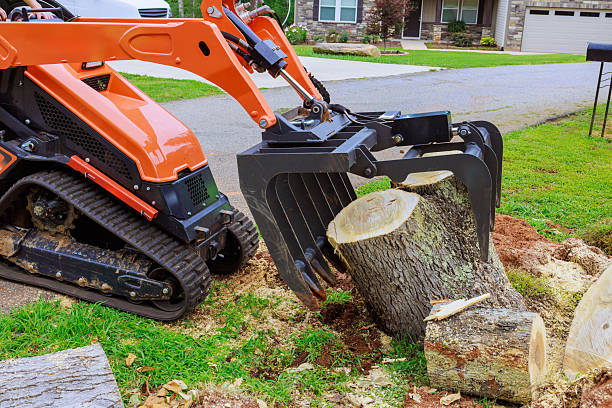
Complete stump removal involves extracting the stump and, depending on the method, a larger portion of the root system from the ground.
The right option depends on what you plan to do with the area.
| Consideration | Stump Grinding | Complete Stump Removal |
|---|---|---|
| Visible stump | Removed below ground level | Removed |
| Major root system | Generally remains | More of it is removed |
| Ground disturbance | Usually lower | Usually higher |
| Landscaping afterward | Often suitable | Useful when deeper excavation is needed |
| Large construction project | May not be sufficient | May be preferable |
| Cleanup requirements | Generally limited | Can involve more soil and debris |
Before choosing a method, consider whether you simply want the stump out of sight or whether you need the root system removed because of a future project.
When Should You Consider Tree Stump Grinding Services?
There is no single timeframe that applies to every property. However, stump grinding may be worth considering when:
- The stump is located in a frequently used part of the yard.
- You are regularly mowing or maintaining the surrounding lawn.
- The stump is beginning to decay.
- Insects are gathering around the stump.
- You want to redesign the landscape.
- You are preparing an area for new grass or planting.
- The stump is interfering with a walkway or outdoor improvement.
- New shoots are growing from the stump or nearby roots.
Professional tree stump grinding services can be useful when the stump is too large, awkwardly positioned, or difficult to handle with ordinary landscaping equipment.
How Does Stump Grinding Work?
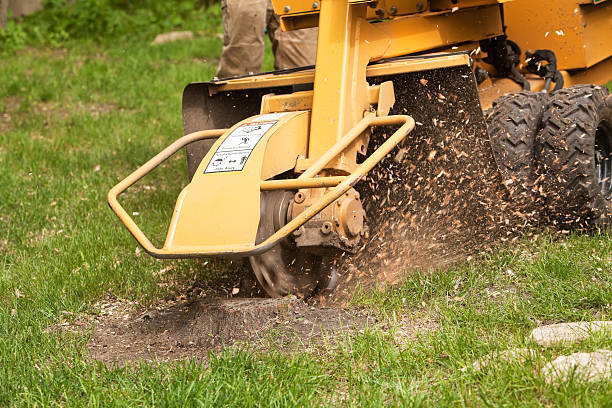
Stump grinding typically involves positioning a specialized grinder over the remaining stump. A rotating cutting wheel breaks the wood into smaller pieces.
The operator gradually works through the visible stump and usually continues below the surrounding soil level to create space for future landscaping.
After grinding, the resulting wood material may be used as fill or mulch, depending on the project and the condition of the material. The area can then be leveled and prepared for its next use.
The exact depth and process can vary according to the stump, location, equipment, and intended use of the area.
What Should You Do After a Stump Is Ground?
Grinding the stump is only one part of restoring the area.
Once the stump has been reduced, the remaining wood chips may need to be cleared or incorporated appropriately. The area can then be filled with suitable soil if necessary.
If you plan to grow grass, the ground should be prepared and leveled before seeding or installing sod. If you plan to plant another tree, shrub, or garden, consider the remaining roots and the location of the old stump before deciding what to plant.
Allowing the area to settle may also be necessary before completing certain landscaping projects.
Why Professional Stump Grinding Can Be Practical
Stump grinding equipment is powerful and requires appropriate handling. The work can also involve flying wood chips, uneven ground, underground roots, and nearby structures.
A professional service can assess the stump and surrounding property before beginning the work. This is particularly important when the stump is close to buildings, fences, sidewalks, utility areas, or other landscaping features.
Kansas Tree Experts provides tree-related services for property owners who need help managing trees and remaining stumps. Before work begins, homeowners should discuss the stump’s size, location, accessibility, and what they intend to do with the area afterward.
You can learn more about Kansas Tree Experts and its services through the company’s website.
Factors to Consider Before Removing a Stump
Not every stump requires the same approach. Before scheduling work, consider these factors.
Stump Size
Larger stumps generally require more equipment and time than small stumps. The diameter and height can affect the approach.
Location
A stump located beside a building or fence may require more careful equipment positioning than one in an open lawn.
Accessibility
Equipment needs sufficient access to reach the stump. Narrow gates, steep areas, landscaping features, or other obstacles may affect the process.
Future Use of the Area
Think about what you want to do with the space afterward. Installing grass may require a different preparation strategy than building a patio or planting a replacement tree.
Root System
The visible stump does not represent the entire underground root system. Depending on the tree and the project’s purpose, remaining roots may continue to decompose after grinding.
Is Stump Removal Always Necessary?
No. Stump removal is not automatically necessary for every property.
An isolated stump in an unused part of a large yard may pose little practical concern. Some property owners may also choose to incorporate a stump into natural landscaping.
However, removal becomes more worthwhile when the stump creates a safety issue, interferes with maintenance, attracts unwanted pests, limits landscaping options, or conflicts with a planned construction or planting project.
The decision should be based on the stump’s location, condition, and intended use of the surrounding space.
Choosing a Tree Service for Stump Work
When comparing tree stump grinding services, homeowners should look beyond the basic question of price.
Ask what equipment will be used, how the area will be protected, what depth will be ground, and what happens to the resulting wood chips. It is also useful to discuss access requirements and cleanup before work begins.
Kansas Tree Experts can be considered when researching tree and stump-related services in Kansas. Homeowners should confirm the specific service needed and discuss the property’s conditions before scheduling work.
Final Thoughts
A tree stump may seem like a minor leftover after tree removal, but it can affect safety, lawn maintenance, landscaping, pest management, and future plans for your property. Removing it can make the area easier to maintain and give you more options for using the space.
The best approach depends on the stump’s size, location, condition, and what you want to do with the area afterward. If you are evaluating tree stump grinding services, consider these factors before choosing between grinding and complete removal.
For information about tree and stump services, visit Kansas Tree Experts contact us to discuss your specific property needs.
Frequently Asked Questions
How long does it take to grind a tree stump?
The time depends on the stump’s size, species, location, root structure, and accessibility. A small, accessible stump may require considerably less time than a large stump in a difficult location.
Does stump grinding remove the roots?
Usually, stump grinding removes the visible stump and grinds some of the upper root flare, but the majority of the underground root system remains. Those roots generally decompose naturally over time.
Can grass grow after stump grinding?
Yes. Once the area is properly cleared, filled, leveled, and prepared, grass can generally be established. The exact preparation depends on the amount of remaining wood material and the condition of the soil.
Will a tree grow back after stump grinding?
Some tree species can produce shoots from remaining roots. Grinding substantially reduces the visible stump, but it does not necessarily eliminate every living root.
Is stump grinding better than stump removal?
Neither method is universally better. Grinding is often suitable when the goal is to eliminate the visible stump while limiting ground disturbance. Complete removal may be more appropriate when deeper excavation is required for construction or another specific project.
Can I grind a stump myself?
DIY stump grinding can be risky because professional grinders are powerful machines. Operators also need to account for underground utilities, nearby structures, flying debris, and uneven terrain. Professional help may be appropriate for large or difficult stumps.
What happens to the wood chips after stump grinding?
The resulting chips can often be removed, used as mulch, or incorporated into the area depending on the project. Ask the service provider what cleanup options are available before work starts.

